
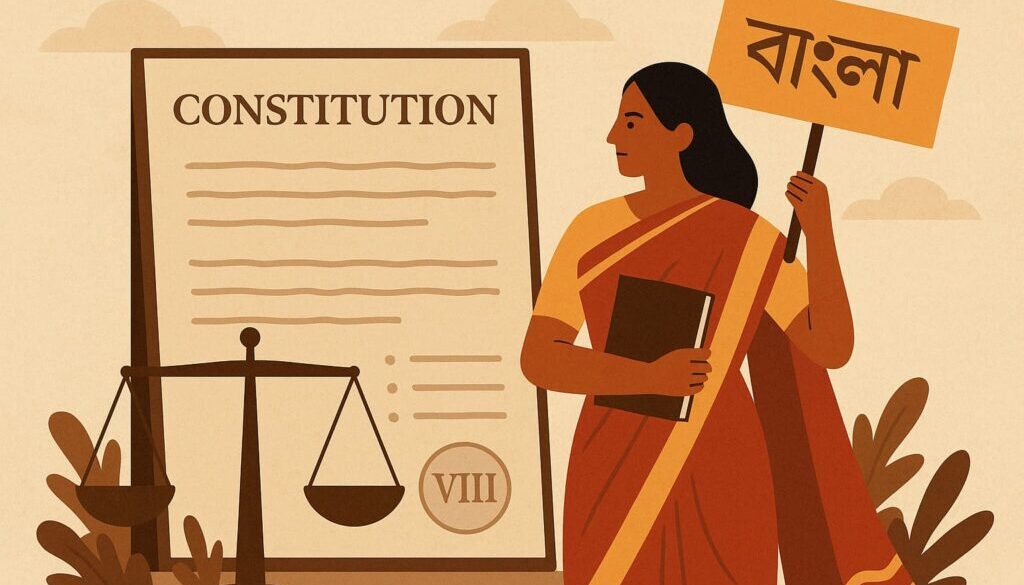
Linguistic Identity Movements in Post-Independence India: Constitutional Safeguards under the Eighth Schedule & the Case of ‘Bengali Asmita’
India’s long struggle to reconcile linguistic pride with national cohesion began with the demand for linguistic Provinces in the 1940s, crystallised in the States Reorganisation Act of 1956, and continues today in campaigns such as the fight for “Bengali asmita.” Constitution‐level safeguards (Articles 29–30 and 343-351), repeated additions to the Eighth Schedule, an evolving policy mix (Official Languages Act 1963, the Three-Language Formula, NEP 2020) and a string of Supreme Court rulings have tried—only partly successfully—to manage these aspirations. The recent elevation of Bengali to “Classical Language” status (2024), the still-pending bid to rename West Bengal as “Bangla,” and flash-point controversies such as a Delhi Police circular branding Bengali “Bangladeshi” show how identity politics, federal bargaining and minority rights remain intertwined.
Historical Evolution of Linguistic Claims
Pre-Independence & Early Republic
-
The Constituent Assembly first cautioned against carving states solely on linguistic lines, commissioning the Dhar Commission (1948) and later the SRC (1953-55).
-
Despite these warnings, popular agitations—most famously the death-fast of Potti Sriramulu—forced the creation of Andhra in 1953. The SRC report nonetheless accepted language as the “most satisfactory” basis for reorganisation, producing the States Reorganisation Act, 1956 that redrew India into 14 states and six Union Territories.
Rise of Mass Linguistic Movements
-
Tamil Nadu’s anti-Hindi agitations (1938, 1965, 1986) entrenched the DMK and ensured that any push toward Hindi as sole official language would face fierce resistance.
-
Gorkhaland exemplifies sub-state identity claims; scholars frame it as a bid to secure cultural distinctiveness rather than mere resource politics.
-
Assamese-Bengali tensions—from the 1960 Official Language Act to the 1961 Barak Valley “language martyrs”—reveal how majority assertion can provoke counter-mobilisation and eventual power-sharing formulas.
Constitutional & Legal Architecture
Key Articles
-
Articles 29-30 guarantee minorities the right to conserve language and to run educational institutions.
-
Articles 343-351 lay down the Union’s language policy, including promotion of Hindi (Art 351) balanced by safeguards such as Art 350A (instruction) and Art 350B (Special Officer/Commissioner for Linguistic Minorities).
Eighth Schedule: From 14 to 22 (and counting)
-
Starting with 14 tongues in 1950, Sindhi was added by the 21st Amendment 1967, Konkani–Manipuri–Nepali by the 71st Amendment 1992, and Bodo–Dogri–Santhali–Maithili by the 92nd Amendment 2003.
-
Inclusion brings funding, Civil-Service exam options and cultural legitimacy—hence fresh demands from Bhojpuri, Kokborok and others.
Statutory & Policy Tools
-
Official Languages Act 1963 codified the Hindi–English compromise for Union business.
-
Three-Language Formula (1968; reaffirmed NEP 2020) seeks to balance regional language, Hindi and English in schools; implementation still varies sharply across states.
Institutions & Judiciary
-
The Commissioner for Linguistic Minorities (est. 1957) submits annual reports on state compliance with language rights—often flagging gaps in bilingual signage and school textbooks.
-
TMA Pai Foundation v. State of Karnataka (2002) held that linguistic (and religious) minorities may establish and administer institutions of their choice, with only reasonable state regulation.
-
State of Karnataka v. Associated Management (2020) struck down a directive forcing all private schools to teach in Kannada, affirming parental choice under Art 19(1)(a).
“Bengali Asmita” in Depth
Symbolic Victories
-
In October 2024 the Union Cabinet granted Bengali “Classical Language” status, acknowledging its 1,000-year literary corpus and distinct antiquity criteria.
Name-Change Campaign
-
The West Bengal Assembly thrice resolved—2011, 2016, 2018—to rename the state “Bangla,” but the Centre has withheld concurrence, citing the need for a constitutional amendment.
Contemporary Flash-points
-
A July 2025 Delhi Police circular describing Bengali as “Bangladeshi” drew all-India condemnation and was portrayed by regional parties as an assault on linguistic plurality.
-
IIT-Kharagpur’s decision to place Bengali alongside Hindi and English on every campus signboard exemplifies institutional assertion of regional language pride in line with NEP 2020.
Federalism, Electoral Politics & Governance
-
Language remains a key axis of bargaining: parties like DMK, AGP, JVM and GJM have won state power or concessions by championing linguistic identity.
-
Centre–state frictions surface whenever policies—civil-service exams, digital governance templates—appear to privilege one language over others. The new restitution of dyadic Hindi-English transcripts in Parliament echoes the 1960s debates.
Comparative International Lens
-
The Bengali Language Movement (East Pakistan, 1952) forged a cultural nationalism that later fuelled Bangladesh’s independence.
-
Sri Lanka’s Sinhala Only Act 1956 shows how privileging a majority language can seed prolonged ethnic conflict and civil war.
Emerging Challenges & Digital Horizons
-
UNESCO’s International Mother Language Day celebrations in New Delhi (2025) positioned India’s NEP as a model for multilingual education, citing the looming extinction of 197 local tongues.
-
Bharatavani and allied AI-translation projects aim to put every scheduled (and unscheduled) language online, yet success hinges on open-source corpora and local scripts.
Conclusion
The arc from the SRC’s re-drawn map to today’s “Bengali asmita” proves that India’s language question is never finally settled; it is managed through a living constitution, policy improvisation and political negotiation. Strengthening watchdog institutions, widening digital access in all scripts, and treating new inclusion demands on transparent criteria—rather than electoral whim—offer the best route to preserving India’s famed “unity in diversity.”